After almost a month in beta test/ rework, SliQ 1.4 is near complete and should be ready for release this week.
The beta testers provided excellent feedback about the usability of some of the features. This shows the benefits of good, independent, objective testing. It took some motivation to reopen the package and rework some of the features - especially the help file - but I knew the tester was making very valid points.
The new release is ready for final test again. 2 days should do it and then 1.4 will be released in stages over the next week or two.
Sunday, 8 June 2008


Tuesday, 6 May 2008
Make the most of Google Adwords using these 10 Tips
When I first created my website up and launched my brand new software package I had one main strategy for selling - get people to visit my site and download the trial copy of my software. Hopefully the software would then sell itself.
From talking with other people who owned websites and who had tried to do e-commerce, I knew it would take lots of work, possibly over many months, to rank well in search engine results. I was told to think about using Pay Per Click (PPC) to get going and that GoogleAds was the only service worth using. I signed up at www.google.co.uk/adwords, wrote my first ad, started getting visitors within an hour and made sales on my first day.
It all seemed so easy - let GoogleAds do the work and sit back waiting for Paypal to tell me people had made a purchase. As the days passed though, the number of visitors clicking through to my site dropped and sales were harder to come by. As I should have expected, nothing in life is ever too easy and I should have done research upfront to optimise my Adwords campaign.
As the days rolled on, I had to up the amounts I was prepared to pay for each click in order to keep getting visitors. I was still making a profit but not much. After a couple of weeks of further research I decided I needed to rethink my whole campaign. I found these tips to be the most useful in improving my conversion rate of clicks to sales:
1. When choosing the keywords for which your ad is to appear, make sure that they are absolutely relevant to your site. I got good click through rates (CTR) for “invoice templates” but at the time my invoicing software package didn’t include multiple templates.
2. Run multiple ads simultaneously. Try different ads to see which work best. Don’t use the same keywords in multiple ads – Google will only show 1 or the other ad and not both.
3. Avoid the word free. I got good CTR for phrases including the word free – like “free invoice software”. In hindsight this was probably a bad choice since those clicks probably weren’t from people wanting to make a purchase of any kind in the first place.
4. You can’t include many words in a single ad. Try selling different benefits in different ads to see which attracts most customers.
5. Write the ads in an attention-grabbing way, don’t just list features. For example – use Special Offer, Time Limited Offer.
6. Sell benefits as well as features – Save Time, No Special Knowledge, Easy to Use.
7. Try ads with and without the price – which works best?
8. Use Google’s free Adwords optimisation service. Look at their suggestions and see if they’ve spotted something your own ads and keywords haven’t covered.
9. Above all, monitor the performance of ads, keep tweaking and try different ads to see which works best. Give an ad a few days to see how it performs before changing it.
10. Use the knowledge you gain while monitoring your ads to optimise the content of the pages on your site and improve your performance in organic search results. Which keywords work best? Do you have pages that clearly focus on those keywords? Can you build backlinks that reinforce the keywords?
When used properly, Google Adwords is a very useful selling tool. Don’t expect to set up a single ad and keep making money however. When you use Google Adwords you are competing in a bidding war. Your competitors will be optimising their campaigns even if you aren’t. Ongoing monitoring and updating of ads is essential to continued success.
From talking with other people who owned websites and who had tried to do e-commerce, I knew it would take lots of work, possibly over many months, to rank well in search engine results. I was told to think about using Pay Per Click (PPC) to get going and that GoogleAds was the only service worth using. I signed up at www.google.co.uk/adwords, wrote my first ad, started getting visitors within an hour and made sales on my first day.
It all seemed so easy - let GoogleAds do the work and sit back waiting for Paypal to tell me people had made a purchase. As the days passed though, the number of visitors clicking through to my site dropped and sales were harder to come by. As I should have expected, nothing in life is ever too easy and I should have done research upfront to optimise my Adwords campaign.
As the days rolled on, I had to up the amounts I was prepared to pay for each click in order to keep getting visitors. I was still making a profit but not much. After a couple of weeks of further research I decided I needed to rethink my whole campaign. I found these tips to be the most useful in improving my conversion rate of clicks to sales:
1. When choosing the keywords for which your ad is to appear, make sure that they are absolutely relevant to your site. I got good click through rates (CTR) for “invoice templates” but at the time my invoicing software package didn’t include multiple templates.
2. Run multiple ads simultaneously. Try different ads to see which work best. Don’t use the same keywords in multiple ads – Google will only show 1 or the other ad and not both.
3. Avoid the word free. I got good CTR for phrases including the word free – like “free invoice software”. In hindsight this was probably a bad choice since those clicks probably weren’t from people wanting to make a purchase of any kind in the first place.
4. You can’t include many words in a single ad. Try selling different benefits in different ads to see which attracts most customers.
5. Write the ads in an attention-grabbing way, don’t just list features. For example – use Special Offer, Time Limited Offer.
6. Sell benefits as well as features – Save Time, No Special Knowledge, Easy to Use.
7. Try ads with and without the price – which works best?
8. Use Google’s free Adwords optimisation service. Look at their suggestions and see if they’ve spotted something your own ads and keywords haven’t covered.
9. Above all, monitor the performance of ads, keep tweaking and try different ads to see which works best. Give an ad a few days to see how it performs before changing it.
10. Use the knowledge you gain while monitoring your ads to optimise the content of the pages on your site and improve your performance in organic search results. Which keywords work best? Do you have pages that clearly focus on those keywords? Can you build backlinks that reinforce the keywords?
When used properly, Google Adwords is a very useful selling tool. Don’t expect to set up a single ad and keep making money however. When you use Google Adwords you are competing in a bidding war. Your competitors will be optimising their campaigns even if you aren’t. Ongoing monitoring and updating of ads is essential to continued success.
Monday, 5 May 2008
Did I choose the right domain name?
A fellow software author tells me we’ve chosen the wrong domain names for the sites selling our products. He says we should have chosen domain names with the product (not company) name in them. I’ve heard this advice before and did consider it when choosing a domain name.
From my point of view, the problem with choosing a product-specific domain name is that it could reduce my options in the future. At the moment I sell one software product but within the next 6 months will be launching 2 more. If I were to have a separate domain selling each product I don’t think I’d have the time or energy to do the link-building. It’s pretty time-consuming doing link-building for one site less alone 2 or 3. On the other hand if I’d chosen a product-specific domain name to begin with, selling different products on the one, original site might not look right.
I used to think the domain name was very important but if you read around, it turns out that URLs are considered more important (and the domain is a specific case of a URL). With a good linking strategy within your site, inner pages can benefit from links to the homepage, e.g. several of my inner pages have a PR only 1 less than the homepage even though they have no links from external sites. These inner pages are often landing pages in searches. So as I sell different products and services I can create pages within my site, like:
http://www.sliqtools.co.uk/invoice-software.aspx
http://www.sliqtools.co.uk/invoice-templates.aspx
and so on.
All in all, I’m pretty happing with my choice of domain name and will continue to build links to one site and, for the time being, mostly to one page – my homepage.
From my point of view, the problem with choosing a product-specific domain name is that it could reduce my options in the future. At the moment I sell one software product but within the next 6 months will be launching 2 more. If I were to have a separate domain selling each product I don’t think I’d have the time or energy to do the link-building. It’s pretty time-consuming doing link-building for one site less alone 2 or 3. On the other hand if I’d chosen a product-specific domain name to begin with, selling different products on the one, original site might not look right.
I used to think the domain name was very important but if you read around, it turns out that URLs are considered more important (and the domain is a specific case of a URL). With a good linking strategy within your site, inner pages can benefit from links to the homepage, e.g. several of my inner pages have a PR only 1 less than the homepage even though they have no links from external sites. These inner pages are often landing pages in searches. So as I sell different products and services I can create pages within my site, like:
http://www.sliqtools.co.uk/invoice-software.aspx
http://www.sliqtools.co.uk/invoice-templates.aspx
and so on.
All in all, I’m pretty happing with my choice of domain name and will continue to build links to one site and, for the time being, mostly to one page – my homepage.
SERPS outside the UK
While my site does well in SERPs in the UK, it doesn’t do well in other countries, e.g the US.
For some competitive search terms I’m on page 1 on http://www.google.co.uk/ but for the same terms in the US I’m below #500. I can also see that my competitor’s .co.uk sites are in the same position. In fact one site, which always ranks #1 for my main search terms comes in a few places lower than me in the US.
So the question is, what can I do to improve my search results? From the research I’ve done so far on the internet and by asking around, it’s been recommended I do 2 things:
1. Host my sites on a US-based server with a .com domain name.
2. Build US-based backlinks to my site.
I’m not sure I understand the first point. If I post a duplicate of my site on a US-based server won’t this be seen as duplicate content? Doesn’t Google penalise for duplicate content?
On the second point, what’s a US-based backlink? Does this mean I need backlinks from .com sites hosted on US-based servers. I can be polite when asking for a backlink but this seems like a tall order.
Need to think this one through ….
For some competitive search terms I’m on page 1 on http://www.google.co.uk/ but for the same terms in the US I’m below #500. I can also see that my competitor’s .co.uk sites are in the same position. In fact one site, which always ranks #1 for my main search terms comes in a few places lower than me in the US.
So the question is, what can I do to improve my search results? From the research I’ve done so far on the internet and by asking around, it’s been recommended I do 2 things:
1. Host my sites on a US-based server with a .com domain name.
2. Build US-based backlinks to my site.
I’m not sure I understand the first point. If I post a duplicate of my site on a US-based server won’t this be seen as duplicate content? Doesn’t Google penalise for duplicate content?
On the second point, what’s a US-based backlink? Does this mean I need backlinks from .com sites hosted on US-based servers. I can be polite when asking for a backlink but this seems like a tall order.
Need to think this one through ….
Sunday, 4 May 2008
How does Web Design differ from SEO?
Modern web design tools, like Microsoft Expression Web or Dreamweaver, make the process of designing a website relatively easy. Using a template, a simple, presentable website can easily be written and posted online. However, getting a website found by people searching online involves more than just making the website look nice. Search Engine Optimisation, or SEO for short, is the activity of making a website rank well in searches on engines like Google and Yahoo.
In some ways making a website look good is of secondary importance: everyone's idea of what looks good is different and nowadays people are used to a reading a range of websites with varying degrees of artistic accomplishment or graphical design standard. What matters most is getting found in the first place and then having content that holds the visitor's interest.
A good web designer will perform both activities – making a good-looking site and making sure the site is well-optimised.
Most website designers will show you their portfolio of websites when you ask them to quote for your website. Good website designers should offer an SEO service too. Ask for examples of how well their client’s sites perform in searches.
If a designer doesn’t offer an SEO service, think twice about using their services – SEO isn’t something that can easily be performed after a website has been written and the pages are online. Ideally, a website needs to be constructed from the beginning with SEO in mind. The choice of URLs, domain names and linking strategy between pages all affect the site’s optimisation and should be planned before the website is written.
The amount of optimisation that can be performed depends on how much time and effort is put in. On-page optimisation (getting the page’s text and internal links to other pages on the same site) can be performed relatively quickly, but off-site optimisation will be an on ongoing task. Off-site optimisation mainly involves getting links from other sites. This can be a very time-consuming activity.
If good ranking in SERPs (search engine result pages) is essential to the success of your site, and you can afford to do so, hire an SEO expert. If you hire someone to do SEO work make sure they explain their techniques to you – at some point you may want to perform your own SEO. In particular, make sure your hired SEO only uses white-hat SEO techniques and will not use so-called black-hat SEO techniques that could result in Google giving your website a penalty or even banning your site in the future.
If you are looking for expert SEO advice and information, I would recommend the services of Four Square Innovations. They helped me with my website and set me on the road to ranking on page 1 of Google for my major search terms.
In some ways making a website look good is of secondary importance: everyone's idea of what looks good is different and nowadays people are used to a reading a range of websites with varying degrees of artistic accomplishment or graphical design standard. What matters most is getting found in the first place and then having content that holds the visitor's interest.
A good web designer will perform both activities – making a good-looking site and making sure the site is well-optimised.
Most website designers will show you their portfolio of websites when you ask them to quote for your website. Good website designers should offer an SEO service too. Ask for examples of how well their client’s sites perform in searches.
If a designer doesn’t offer an SEO service, think twice about using their services – SEO isn’t something that can easily be performed after a website has been written and the pages are online. Ideally, a website needs to be constructed from the beginning with SEO in mind. The choice of URLs, domain names and linking strategy between pages all affect the site’s optimisation and should be planned before the website is written.
The amount of optimisation that can be performed depends on how much time and effort is put in. On-page optimisation (getting the page’s text and internal links to other pages on the same site) can be performed relatively quickly, but off-site optimisation will be an on ongoing task. Off-site optimisation mainly involves getting links from other sites. This can be a very time-consuming activity.
If good ranking in SERPs (search engine result pages) is essential to the success of your site, and you can afford to do so, hire an SEO expert. If you hire someone to do SEO work make sure they explain their techniques to you – at some point you may want to perform your own SEO. In particular, make sure your hired SEO only uses white-hat SEO techniques and will not use so-called black-hat SEO techniques that could result in Google giving your website a penalty or even banning your site in the future.
If you are looking for expert SEO advice and information, I would recommend the services of Four Square Innovations. They helped me with my website and set me on the road to ranking on page 1 of Google for my major search terms.
SoftTester: Top UK Freeware & Shareware Site
Distributing shareware is as important as writing the software in the first place – if people can’t find your software titles they can’t buy them. If your website is new and doesn’t perform well in searches on Google, the easiest way to distribute your software online is via one of the numerous shareware sites.
Shareware sites will allow you to advertise your software for free. For each title, you will be able to post a short description and the shareware site will provide a link to your installable package.
The majority of shareware sites are based in the US and are used by US customers. If your software is targeted solely for the UK, you may find that you are wasting download bandwidth from your site – since people in the US will download your package but will soon find that it isn’t appropriate for them. This happened to me with one of my software titles – I had to upgrade my hosting package to cater for the extra downloads.
One of the best freeware/ shareware sites in the UK is SoftTester. SoftTester has been established for a number of years and receives up to several thousand visitors a day.
SoftTester goes a couple of steps beyond the usual shareware site in that it tries to build communities amongst software developers, encouraging reviewing and testing of each others software.
SoftTester accepts the submissions using the standard shareware PAD file and from personal experience I can say that the site owner is very friendly and helpful to new authors.
Shareware sites will allow you to advertise your software for free. For each title, you will be able to post a short description and the shareware site will provide a link to your installable package.
The majority of shareware sites are based in the US and are used by US customers. If your software is targeted solely for the UK, you may find that you are wasting download bandwidth from your site – since people in the US will download your package but will soon find that it isn’t appropriate for them. This happened to me with one of my software titles – I had to upgrade my hosting package to cater for the extra downloads.
One of the best freeware/ shareware sites in the UK is SoftTester. SoftTester has been established for a number of years and receives up to several thousand visitors a day.
SoftTester goes a couple of steps beyond the usual shareware site in that it tries to build communities amongst software developers, encouraging reviewing and testing of each others software.
SoftTester accepts the submissions using the standard shareware PAD file and from personal experience I can say that the site owner is very friendly and helpful to new authors.
SliQ 1.4 Screenshots
These are screenshots of the software package being tested today. SliQ 1.4 is a big update on previous versions. At first glance not much looks different, but 1.4 supports service invoices, discounts on invoices and quotes, 9 different templates in a range of colours, enhanced payment tracking, configurable currencies and taxes plus more.
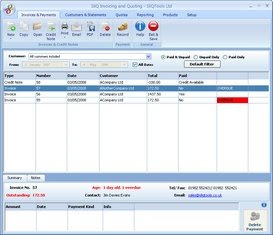
This is the main Invoices & Payments screen from SliQ Invoicing and Quoting 1.4. The screen has been modified to incorporate the extra payments info.
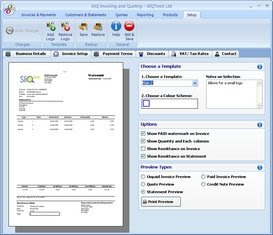
The template setup tab. On this tab you can choose different templates for your invoices, quotes, credit notes and so on. 9 templates are supported with a range of different colour schemes. 1.4 also allows custom templates to be created for different users.
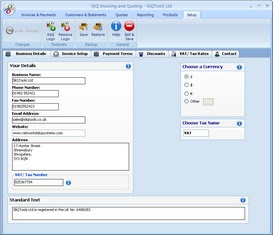
This tab allows you to enter your business details, select or specify a currency and enter the tax name and standard information like payment options.
This is the main Invoices & Payments screen from SliQ Invoicing and Quoting 1.4. The screen has been modified to incorporate the extra payments info.

The template setup tab. On this tab you can choose different templates for your invoices, quotes, credit notes and so on. 9 templates are supported with a range of different colour schemes. 1.4 also allows custom templates to be created for different users.

This tab allows you to enter your business details, select or specify a currency and enter the tax name and standard information like payment options.

Testing going well
Testing went well yesterday. Found few problems compared to the previous day.
All in all the new release is looking good and stable. Decided to make some last-minute cosmetic changes. Now all I need to do is update the help file before letting the beta testers loose.
I had a couple of potential customers asking about features. One needs a different invoice format. He loves the software but needs a different invoice template. It's reassuring that he liked the software enough to ask for an update rather than move on to try out someone else's package. Luckily the next version will include multiple invoice templates so I can give the customer what he wants. I emailed him PDFs from SliQ 1.4 and he OKed one of them as being suitable. Should get a sale with any luck.
All in all the new release is looking good and stable. Decided to make some last-minute cosmetic changes. Now all I need to do is update the help file before letting the beta testers loose.
I had a couple of potential customers asking about features. One needs a different invoice format. He loves the software but needs a different invoice template. It's reassuring that he liked the software enough to ask for an update rather than move on to try out someone else's package. Luckily the next version will include multiple invoice templates so I can give the customer what he wants. I emailed him PDFs from SliQ 1.4 and he OKed one of them as being suitable. Should get a sale with any luck.
Saturday, 3 May 2008
Testing is hard work
Today I'm testing a major new release of software. The test/ review phase has been ongoing for about 3 weeks. We've been doing rounds of test interspersed with rounds of independent review by Sue the director.
I don't find testing very interesting. These days I find it hard to concentrate for more than 20 minutes and the temptation to tweak and improve is fairly irresistible.
If I'm lucky I'll get about 6 clear hours today to concentrate on testing. If we can clear the testing soon we should be able to release for beta test within the next fortnight.
My biggest distraction is the internet. I'd get along better if BT cut me off.
I don't find testing very interesting. These days I find it hard to concentrate for more than 20 minutes and the temptation to tweak and improve is fairly irresistible.
If I'm lucky I'll get about 6 clear hours today to concentrate on testing. If we can clear the testing soon we should be able to release for beta test within the next fortnight.
My biggest distraction is the internet. I'd get along better if BT cut me off.
Friday, 2 May 2008
5 Things to Consider Before Starting Your Own Business
Have you ever felt like starting your own business? Do you want to be your own boss? Want to get away from the day-to-day monotony of your current job and be in control of your own life? Well, if you do, there is only person who can make the difference between your new business being successful and being a disaster – you!
Before you begin your new life running a business, consider the following questions. If you can answer the questions honestly, you should be in a good position to start up a business.
Are you starting a new business or running away from something?
Don’t expect running a business to solve too many issues for you. Starting your own business may not turn out to be a route to a magically fulfilling life.
For example, did you decide to set up a business while on holiday? Many people think about changing their lives while on holiday, especially when faced with returning home and getting back into their normal work routine. Be sure that you are considering starting a business for the right reasons. Television shows many programmes about people who sold up and moved to a new life running their own business. To me, unless these people have already retired from work, they often seem to regret the move.
Be honest about the amount of effort involved
If you work in a company and things go badly or run late, you can always fall back on your colleagues or your boss to help. When you run your own business you will have to rely on yourself. This may mean working late at night and at weekends. If you work from home you may find it difficult to switch out of work mode if your office is just across the hallway. In the early days, while getting the business up and running, you may be working long hours and seeing little profit. Are you the kind of person who has the discipline and self-motivation to carry on?
Will you make a living from your business?
Most people will need to make a living from their business. Have you written a business plan and worked out exactly how much profit your chosen business will realistically make? Don’t start your assessment by thinking how much money you need to earn each month to pay the bills. If you do this you may end up “adjusting” profit figures to meet your needs.
Be honest about the likely profits. Do research. Get someone independent, in a similar business if possible, to talk through the likely costs and income. Work out your likely profit or losses in the months after you start your business. How long will it take you to make a living? How will you afford to live before the business is making a living wage?
Will you over commit yourself or your family?
When you start your own business it is likely you will end up working more hours than you did working for someone else. At the end of the day, the only person you can rely on to get the job done is you.
Consider the effect this will have on your partner or children. If you have very young children, will they understand why you can’t spend as much time with them? Will your partner understand?
Will you expect your partner, husband or wife, to help out when things get tough? Is this fair? Will they end up feeling pressured even when they have their own work commitments? Be honest with each other and discuss the possibilities before starting your business.
How many roles will you play?
If you work for a company, it’s likely – even though you may not think so – that you do only one job. When you work for yourself you will probably need to do many jobs. If you are setting up a one man business think: Who will do the marketing and advertising? Who will fulfil customer orders, e.g. by packing and posting goods? Who will deal with customer queries and complaints? All these roles require different skills. If you don’t have any experience in these areas, get training or advice and be prepared to learn quickly on the job.
Conclusion
I hope you find this list useful. The list isn’t meant to put you off starting your own business. Rather it is meant to help you make sure you are being honest with yourself about your expectations and the possible pitfalls in working for yourself. If you plan up front, running your own business can be a rewarding and satisfactory venture.
Before you begin your new life running a business, consider the following questions. If you can answer the questions honestly, you should be in a good position to start up a business.
Are you starting a new business or running away from something?
Don’t expect running a business to solve too many issues for you. Starting your own business may not turn out to be a route to a magically fulfilling life.
For example, did you decide to set up a business while on holiday? Many people think about changing their lives while on holiday, especially when faced with returning home and getting back into their normal work routine. Be sure that you are considering starting a business for the right reasons. Television shows many programmes about people who sold up and moved to a new life running their own business. To me, unless these people have already retired from work, they often seem to regret the move.
Be honest about the amount of effort involved
If you work in a company and things go badly or run late, you can always fall back on your colleagues or your boss to help. When you run your own business you will have to rely on yourself. This may mean working late at night and at weekends. If you work from home you may find it difficult to switch out of work mode if your office is just across the hallway. In the early days, while getting the business up and running, you may be working long hours and seeing little profit. Are you the kind of person who has the discipline and self-motivation to carry on?
Will you make a living from your business?
Most people will need to make a living from their business. Have you written a business plan and worked out exactly how much profit your chosen business will realistically make? Don’t start your assessment by thinking how much money you need to earn each month to pay the bills. If you do this you may end up “adjusting” profit figures to meet your needs.
Be honest about the likely profits. Do research. Get someone independent, in a similar business if possible, to talk through the likely costs and income. Work out your likely profit or losses in the months after you start your business. How long will it take you to make a living? How will you afford to live before the business is making a living wage?
Will you over commit yourself or your family?
When you start your own business it is likely you will end up working more hours than you did working for someone else. At the end of the day, the only person you can rely on to get the job done is you.
Consider the effect this will have on your partner or children. If you have very young children, will they understand why you can’t spend as much time with them? Will your partner understand?
Will you expect your partner, husband or wife, to help out when things get tough? Is this fair? Will they end up feeling pressured even when they have their own work commitments? Be honest with each other and discuss the possibilities before starting your business.
How many roles will you play?
If you work for a company, it’s likely – even though you may not think so – that you do only one job. When you work for yourself you will probably need to do many jobs. If you are setting up a one man business think: Who will do the marketing and advertising? Who will fulfil customer orders, e.g. by packing and posting goods? Who will deal with customer queries and complaints? All these roles require different skills. If you don’t have any experience in these areas, get training or advice and be prepared to learn quickly on the job.
Conclusion
I hope you find this list useful. The list isn’t meant to put you off starting your own business. Rather it is meant to help you make sure you are being honest with yourself about your expectations and the possible pitfalls in working for yourself. If you plan up front, running your own business can be a rewarding and satisfactory venture.
Subscribe to:
Posts (Atom)